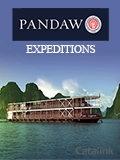
Pandaw has been pioneering luxury river expeditions across Asia since 1995, when Scottish historian Paul Strachan revived the grand tradition of Irrawaddy river travel by rebuilding a classic colonial-era steamer. The company operates a fleet of 17 handcrafted brass-and-teak vessels, each carrying fewer than 30 cabins, designed in the style of the historic Irrawaddy Flotilla Company that once connected communities along Burma's great rivers. Pandaw's ultra-shallow-draft ships are specially built to navigate remote waterways that larger vessels simply cannot reach, giving passengers access to landscapes and communities rarely seen by outside travellers. Over three decades the company has expanded from its Irrawaddy roots to cover rivers across six Asian countries, earning a reputation as one of the continent's leading small-ship river cruise operators.
Pandaw expeditions span some of Asia's most celebrated and least-explored waterways. On the Irrawaddy in Myanmar, cruises journey deep into the Burmese heartland, passing ancient pagodas and traditional villages. The Mekong itineraries link Vietnam, Cambodia, Laos and Thailand, tracing one of the world's great rivers from its lower delta communities to the upper reaches near China's Yunnan province. In India, Pandaw sails both the Ganges and the Brahmaputra, two rivers of immense cultural and natural significance. The Red River in northern Vietnam offers a further distinct perspective on the region. Each route is designed around going ashore: guided excursions reveal temple complexes, floating markets, hill-tribe settlements and riverside craft workshops that rarely appear on mainstream itineraries.
Every Pandaw vessel is individually crafted using teak, brass and traditional joinery methods, giving each ship a character that mass-produced cruise ships cannot match. Cabins are kept deliberately limited – typically between 10 and 28 per vessel – to preserve an intimate, expedition-style atmosphere. The shallow draft, low profile and flat-topped design allow the boats to slip under low bridges and navigate shallow seasonal channels, opening up stretches of river that mark the true frontier of river cruising in Asia. Crew and guides are locally recruited, bringing first-hand knowledge of the regions through which guests travel. All-inclusive pricing removes the worry of hidden costs, with meals, excursions and on-board drinks typically bundled into the fare.
Pandaw's founding story connects directly to one of the great maritime enterprises of the colonial era. The Irrawaddy Flotilla Company, established by Scottish merchants around 1865, grew to operate more than 650 vessels along Burma's rivers before its fleet was deliberately scuttled during World War II to prevent capture. Paul Strachan, a Burma scholar with deep knowledge of that history, set out in 1995 to revive the spirit of those river voyages. The original rebuilt steamer, named Pandaw, gave the company its name and its ethos: historically informed, expertly crewed, and committed to reaching the places that mass tourism overlooks. By 2025 Pandaw marked its 30th anniversary as Asia's leading independent river cruise operator.
Pandaw sails on the Irrawaddy in Myanmar, the Mekong through Vietnam, Cambodia, Laos and Thailand, the Red River in northern Vietnam, and the Ganges and Brahmaputra in India. New itineraries have extended the range to the upper Mekong near China's Yunnan province.
Pandaw vessels are deliberately small. Cabins range from around 10 to 28 per ship, meaning passenger numbers typically run between 20 and 56. The smallest boats, such as those deployed on the upper Mekong in Laos, carry as few as 20 guests alongside a crew of around 20.
Pandaw generally operates on an all-inclusive basis, with meals, guided shore excursions and drinks on board included in the headline fare. This approach means travellers can budget for the full experience without encountering unexpected add-on charges during the voyage.
Pandaw ships are purpose-built with an ultra-shallow draft and low clearance, allowing them to navigate rivers and channels beyond the reach of conventional river cruise vessels. Combined with small passenger numbers, locally recruited guides and an expedition-style focus on going ashore, the experience is closer to a private exploration than a packaged holiday.
Yes. As of 2025 Pandaw celebrated its 30th anniversary and continues to operate 17 vessels across its Asian river network, with departures scheduled through 2026, 2027 and 2028 listed on the company's official website.
Pandaw was founded in 1995 by Paul Strachan, a Scottish historian and author specialising in Burma. Strachan was inspired by the legacy of the Irrawaddy Flotilla Company and set out to revive the tradition of colonial-era river travel on Asia's great waterways.
This brochure is part of the Catalink archive and may no longer be available to order. The information above describes Pandaw. For current details, visit the company's official website.
This brochure is no longer available
The Pandaw Expeditions Overview Brochure brochure has been archived — details above are kept for reference. Browse similar live offers available free today.
Browse Live Brochures →Similar to Pandaw Expeditions Overview Brochure and available now — order any of them free.